
What is professional services automation (PSA) software?

Last updated: October 2026 

TL;DR: PSA software is the system a services firm runs between its CRM and its accounting software. Won deals become projects, people are planned on them, and approved hours become invoices, so you see margin while the work is still open.

Your sales team closes a deal in the CRM. Then the work moves into a project tool, hours go into a time tracker, planning lives in a spreadsheet, and finance builds the invoice from all three. Every handover is a chance to lose an hour or retype a rate. And the margin usually shows up weeks after the project closed, when nothing can be fixed. PSA software, short for professional services automation, closes that gap by running the work from won deal to invoice in one system.

psa software
  

What is PSA software?

PSA software, or professional services automation software, is a business system for firms that sell expertise by the project or by the hour. It runs the work between the sale and the invoice: contracts, projects, people, time and billing, in one place. Your CRM stays the home of the sale, and your accounting software stays the home of the books. You'll also see it called a PSA tool, PSA system or PSA platform, and it's one type of professional services software.

PSA has been a defined software category since 1999, when Dave Hofferberth, then an analyst at Aberdeen Group, published the first white paper on it. According to SPI Research's history of PSA, the core he described was project management, resource planning, time tracking, billing and financial forecasting.

What makes it a PSA is that these jobs share one set of data and connect to the systems on either side: your CRM before the work starts and your financial systems after it. A PSA is defined as much by what it connects to as by what it does on its own.


What does PSA software do?

A PSA covers six jobs that many firms spread across separate tools: contracts and quotes, projects, resource planning, time and expenses, invoicing, and reporting. Each job feeds the next. One approved hour updates the project budget, the margin report and the next invoice at once, and nobody has to copy it across.

Contract and quotes

The contract sets what the client pays for: a fixed fee, time and materials, a retainer, installments or milestones. In a PSA, each contract line carries a budget and a rate. Every hour logged later is measured against what was sold, so you get a warning while the budget still has room.

Read more about contract management in a PSA.

Project Management

Projects, phases, tasks and deadlines, as in any project tool. The difference is that a PSA project knows its money. Planned hours, actual hours and budget burn sit next to the task list, so a project manager sees drift while there's still time to act.

See how project management works inside a PSA.

Resource and capacity planning

Who is free next month, who is overbooked, and which skills you'll need when pipeline deals close. A PSA plans people against real projects and real availability, instead of a spreadsheet one person keeps up to date.

Read about resource and capacity planning.

Time and expense tracking

Everyone who works on a project, from specialists to project managers, records hours and expenses against a project, a task and a contract line. A manager reviews and approves them. Because each entry carries a rate, an approved hour is a cost, a budget update and a billable line at the same time. A late timesheet holds up every report and invoice after it.

See time and expense tracking.

Invoicing and billing

Approved hours, expenses, milestones and installments become draft invoices. Someone checks and approves them. The PSA then transfers the approved invoices to your accounting software, which issues the final invoice and records the payment. Because the billing rules live with the project, finance no longer rebuilds them from exports each month.

Learn how invoicing from project data works.

Reporting and operations

Because everything above sits in one system, reporting stops being a monthly project. Utilization, margin per project and client, work in progress and revenue still to bill all come from live data. Leadership and project managers see the same numbers.

"PSOHUB helps me have all the information about my projects on one platform, understand time usage and client attention, and with fast and reliable dashboards, it improves my management as a Project Manager."

Carolina Z., Marketing Automation Consultant (G2 review)


How does PSA software work with your CRM and accounting system?

A PSA sits in the middle. Your CRM owns the deal until it's won. The PSA takes over from there and owns the project, the people, the hours and the billing rules. Your accounting software owns the final invoice, the ledger and the payment. Each system keeps its own job, and data moves forward once.

Flow diagram of PSA software between the CRM and the accounting or ERP system: a won deal in the CRM becomes projects, people, time and billing in the PSA, the final invoice and payment sit in accounting, and payment status flows back to the PSA

At a typical services firm, the work moves through seven steps:

  1. The deal is won. Sales marks the opportunity as won in the CRM.
  2. The project is set up. The PSA creates the project from the client details, contract lines and budget agreed in the deal.
  3. The team is scheduled. Operations assigns people to the project based on their skills and availability.
  4. Time and expenses are recorded. Team members register their hours and expenses on the project, and a manager approves them.
  5. The invoice is prepared. The PSA turns approved work, milestones and installments into a draft invoice, which finance reviews and approves.
  6. The invoice is issued. The approved invoice is transferred to the accounting software, which issues the final invoice and records it in the books.
  7. Payment is tracked. The payment status syncs back to the PSA, so each project shows what has been invoiced and paid.

Digital Reach, a digital marketing and rev ops agency, runs this flow with HubSpot and Xero. Its Chief Revenue Officer, Mandy, describes the first step: "I can deploy the contract from HubSpot so that it automatically creates the project in PSOhub." From there, invoices go to Xero on schedule and reconcile back once they're paid. Read the Digital Reach story.

Dave Hofferberth, who first mapped PSA as a category, put the reason in one line in a 2020 interview:

"The secret sauce is that everything is information-driven, so if you don't have the information infrastructure, you're never going to be able to be successful."

Dave Hofferberth, founder of Service Performance Insight (full interview)

If your deals live in HubSpot, this walkthrough of how a HubSpot deal becomes a project shows step 2 in practice: the company, contacts and deal amount carry over without retyping.


How is PSA software different from a CRM, an ERP or a project management tool?

Each tool owns a different stretch of the same client relationship. A CRM owns the sale. A project management tool owns the tasks. An ERP or accounting system owns the books. A PSA owns delivery and its economics: the people, hours, budgets and billing rules in between. Knowing this tells you where each piece of data belongs.

  CRM Project management tool PSA software ERP or accounting
Main job Win the deal Organize tasks and deadlines Run delivery profitably Keep the official books
Owns Pipeline, contacts, deal value Tasks, timelines, collaboration Projects, people, time, budgets, billing rules Ledger, receivables, tax, payroll, final invoices
Main users Sales Project teams Operations, project managers, delivery teams, finance Finance
Where it stops Once the deal is won At money: no rates, budgets or invoices At the general ledger At day-to-day delivery


PSA vs CRM: where does the handover happen?

The handover happens when the deal is won. Until then, the CRM is the right home for the client, the promise and the price. After that, the work needs things a CRM wasn't built for, like rates per role, approved hours and budget burn. Connect the two, because retyping the deal is where scope and budgets first go wrong.

PSA vs ERP: does a PSA replace your ERP?

No. An ERP runs the business around the work: the general ledger, payroll, tax, compliance and reporting across entities. A PSA runs the work itself. A firm can run a PSA next to plain accounting software and add an ERP later, once multi-entity finance becomes the bigger problem. Our comparison of PSA and ERP for professional services covers which should come first.

PSA vs project management software: what's missing from a project tool?

Money. A project management tool tracks tasks, owners and deadlines well, but it doesn't know what an hour costs or how much budget is left, so firms build spreadsheets on top. A PSA includes project management and adds rates, budgets, approvals and invoicing, which is why it's sometimes described as professional services project management software.


Who needs PSA software?

Firms that sell their people's expertise, by the project or by the hour, use professional services automation software. That covers most of professional services: marketing agencies, software, tech and IT services, financial services and accounting, architects and engineers, and consulting firms. What they share is that revenue depends on how well people's time is planned, used and billed.

psa software

Digital marketing and advertising agencies

Agencies use PSA software to automate their entire customer lifecycle from marketing to sales to project management to invoicing. When paired with marketing and sales tools, PSA software can help unlock new revenue and opportunities.


Learn more >

psa software

Software, High-Tech and IT services companies

Whether you develop software or provide IT services, PSA solutions can help you manage your resources. Software, high-tech, and IT firms benefit significantly from time tracking and project management features.


Learn more >

psa software

Financial services and accounting

Revenue from billable hours or fixed-price projects can be managed easily using PSA software. Are you productizing your services? PSA software can help with that, too.


Learn more >
psa software

Architecture and engineering firms

Spend less time on admin work and more time getting projects across the finish line. PSA software makes life easier for construction professionals through smart, self-driving automation features.


Learn more >


What are the benefits of PSA software?

The main benefit is earlier, more reliable numbers. With hours, budgets and billing in one system, you see margin while a project is still running and fewer hours slip through unbilled. Independent research points the same way, though most of it is self-reported.

The alternative carries its own risk. Raymond Panko's review of spreadsheet field audits found errors in at least 86% of the spreadsheets checked in the more rigorous audits. Planning and billing from spreadsheets means relying on files that are usually wrong somewhere.

ITSEC, a cybersecurity and compliance consultancy, had time tracking, financial data and planning spread across different tools. After moving them into one PSA, ITSEC reports that timesheet completion reached 99% within four months. Data for monthly reviews that used to take days to pull together is now ready in seconds. Its CFO, Sebastien, says: "Without PSOhub, we would struggle to maintain visibility into project performance and margins." Read the ITSEC story.

business-trend
online-analytics
position-badge
Less admin, more billable hours
 With the right PSA software, an organization can easily save 100 hours of admin work per employee per year!
Massive revenue growth
 Businesses using PSA software have experienced YoY revenue growth of more than 143%.

Improved customer satisfaction
PSA software enables close collaboration between sales and project teams and improves the client experience.

PSA software for project management

Project management is one of the biggest challenges for professional services organizations. Closing a deal is one thing. Getting the work done on time, within budget, and in alignment with project scope is another.

Across industries, project managers have one thing in common — they have a lot of responsibilities (defining deliverables; setting goals; creating schedules, budgets, and timelines; and allocating resources, to name a few).

Unfortunately, without the right tools, project managers often end up spending more time and energy on managing their project management processes than they spend on...well...actual project management. Every moment spent switching between platforms, building spreadsheets, manually entering information, and fixing errors is time that would be better spent on client work.

In order to keep things on track, project managers also need visibility into every aspect of the process. How much money has been spent? How much is left? Are deadlines being met? Does some aspect of the project need to be reevaluated? How does progress on this project compare to other projects?

In an ideal world, answering these questions would be easy. But sifting through spreadsheets and parsing together reporting from multiple platforms takes time and effort — and in the end, the answers still might not be clear.

Look for these project management features in a PSA platform:

communication-network

Automated project setup

A self-driving project setup system saves time and reduces repetitive work so your team can get started on client work right away.

year-planner (1)

Project planning

A good PSA platform will enable you to plan projects — using Gantt charts, checklists, and more — directly from your CRM ecosystem, closing the gap between sales and service.

campaign

Project status tracking and alerts

Progress tracking for all your accounts gives you better visibility, and automatic alerts let you know if any projects are getting off track.

corporate-presentation

Dashboards and reporting

Reporting features give you the opportunity to learn from completed projects so you can optimize your project management strategy.

PSA software for time tracking

Professional services work (and project-based work in particular) requires accurate time tracking methods. The reasoning here is obvious — for many companies, hours worked on a project determines how much to bill the client. If you can’t bill accurately, you could be losing money.

However, timekeeping isn’t just about billing. It’s also a key component of project management that can help keep your team from going over budget and overservicing clients.

A 2019 survey conducted by Ginger Research found that 90% of PR agencies overservice accounts. Similarly, a report by the Society of Digital Agencies found that 49% of creative agencies reported a profit loss of 11% or more due to overservicing, with 57% citing lack of visibility into overservicing as a reason for profit loss.

Timekeeping errors (28%) and timekeeping delays (27%) — which can often contribute to overservicing — were also cited.

Talk to professionals from other service industries — like accounting, engineering, and IT — and you’ll likely hear similar stories.

90% of PR agencies overservice accounts.

86% of staff at PR agencies have worked unpaid overtime due to overservicing.

49% of creative agencies have experienced a profit loss of 11% or more due to overservicing

57% of creative agencies cite lack of visibility into overservicing as a key reason for profit loss.

It’s clear that overserviced projects are a huge problem for services companies. Luckily, the right time tracking solution can help put the brakes on overservicing.

There are a variety of time tracking platforms available online, and many of them are free. It’s important to keep in mind that they all have their own pros and cons, and some might even create more work for your team, so automation is highly valuable.

Unlike stand-alone time tracking solutions, comprehensive PSA software can use your timesheets as a key source of project information.

Here are some key time tracking features to look for in a PSA platform:

financial-idea

Automatic alerts

When too many (or too few) hours are logged to a project, an immediate alert lets you know that things are in danger of getting off-track — so you can make adjustments and stop overservicing before it starts.

jigsaw

CRM integration

Viewing time logs directly from your CRM eliminates extra steps and saves time.

employee-card

Custom rolesCustom roles and hourly rates

Good PSA software will enable you to assign multiple roles to each team member, letting them track time with different billable rates based on the job they’re currently performing.

rocket

Self-driving features

Calendar integrations make time tracking a breeze for team members, and can reduce time tracking errors.

PSA software for invoicing and billing

No matter your industry, you share at least one common goal with other professional services organizations: getting cash in hand as soon as possible.

But without an optimized invoicing and billing system, that goal can be nearly impossible to achieve.

Even if you’re happy with your current invoicing and billing platform, integrating it with PSA software can help you get more from it.

psa software

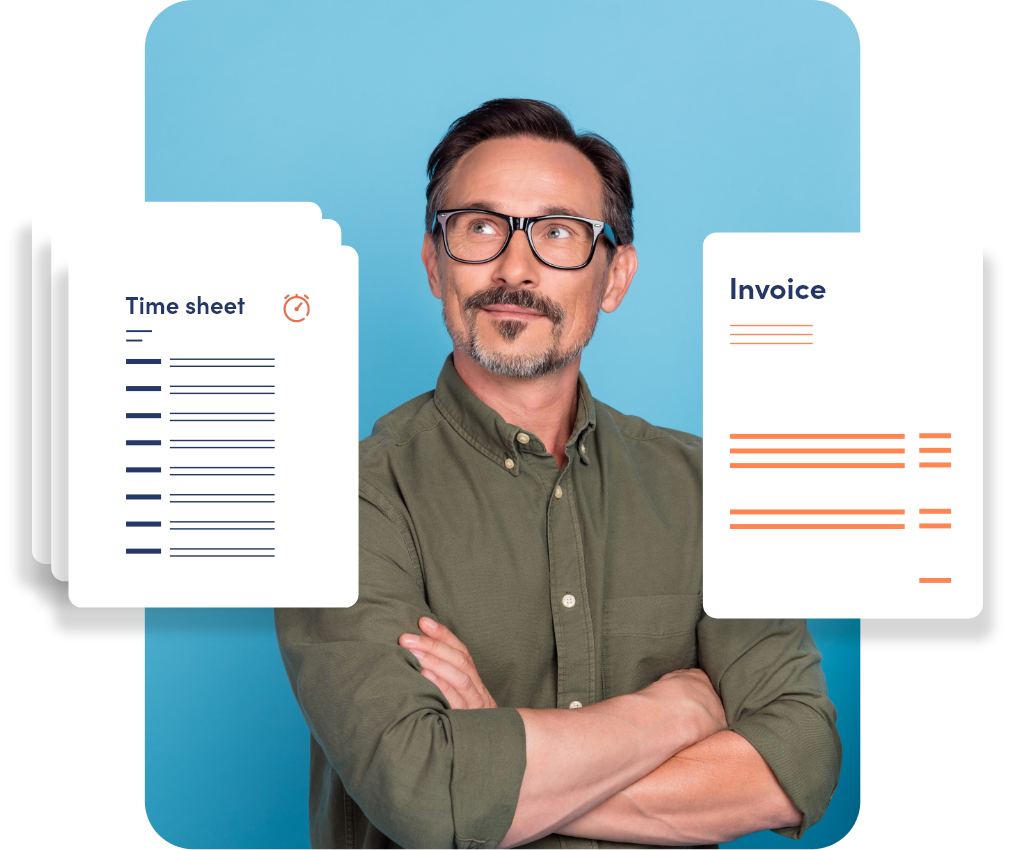
Automated invoicing and billing options can significantly reduce manual work so invoicing doesn’t become a post-project chore.

But not every engagement or project looks exactly the same, especially when it comes to billing, so automation without custom options won’t necessarily help.

Time and material, recurring, milestone, installment-based — a good PSA solution will make it easy to generate and send any kind of invoice, whether you choose to send them manually or based on triggers from your project management workflows.

Here are some key time tracking features to look for in a PSA platform:

coin-pouch

Invoicing automation

Automatic invoice generation (e.g. when a certain number of billable hours are logged or when a particular milestone is reached) reduces manual work for your team and helps you get paid faster.

jigsaw

Accounting software integrations

Bring the benefits of automation into your existing processes. If your current invoicing/billing platform is working well for your organization, choose a PSA platform that integrates with it.

business-presentation

Custom invoice approval options

Recurring and installment invoices don’t always need manual approval, while complex projects might need extra review. A good PSA platform will allow you to customize your settings and select manual or automatic approval for each project.

business-trend

Integrated invoice tracking

You should be able to quickly identify which clients have or haven’t paid up. And when your team can view invoice status right from your CRM, it keeps everyone on the same page.


PSA software for operations

Project management, time tracking, and invoicing are all part of your organization’s internal operations, so increasing efficiency for each component also increases overall operational efficiency. This increase can be even more dramatic with PSA software that closes the gaps between each component.

On a day-to-day level, PSA software can streamline workflows in all the ways we’ve already discussed. It can also boost visibility across departments, highlighting opportunities for operational improvement.

With a birds-eye view of workforce capacity, project data, margins, and client satisfaction metrics, you can:

  • Keep track of the admin hours required to close a deal and factor that into your costs
  • Pinpoint and address recurring issues like scope creep
  • Forecast profitability and plan resources more accurately
  • Strategically target satisfied clients for up-selling and cross-selling
  • Track your best-performing and worst-performing accounts
  • Identify your best-performing team members

In other words, a great PSA platform is a data goldmine that helps inform decision making around operational efficiency — which is why PSA software is particularly valuable for operations managers, managing partners, and business owners who are calling the shots.


When does a firm need PSA software, and when not yet?

You need a PSA when the gaps between your tools cost more than the tools themselves: hours arrive late, invoices are built by hand and margin appears after the project has closed. You don't need one yet if a few people run a few projects and one person still holds the whole picture.

Signs you've outgrown spreadsheets and separate tools:

  • Won deals get retyped into a project tool.
  • Timesheets are chased every week, and invoices wait for them.
  • Planning lives in one person's spreadsheet.
  • Project margin is only known after the month-end close.

"PSOHUB has solved the problem of disconnected business processes between our CRM, time tracking, and invoicing. Before PSOHUB, we had to manually move data across multiple platforms, which led to administrative errors and wasted hours. Now everything flows automatically from one step to the next."

Ikram Muh. A., Security Analyst (G2 review)

It can also be too early. In the same 2020 interview, Hofferberth's rule of thumb was that a five-person firm can manage in Excel, but at around 20 people it gets too hard to do everything well. A firm that bills few hours or runs a handful of simple projects may do better with a good time tracker and its accounting software. The right moment comes when coordinating people, projects and billing turns into a weekly struggle.

If you're past that point and comparing tools, the PSA buyer's scorecard gives you a weighted way to do it.

Dave_Hofferberth


“Everything is information-driven, so if you don’t have the information infrastructure, you’re never going to be able to be successful.”

Dave Hofferberth, Managing Director, Service Performance Insight

How to choose the best PSA software for your business

There are five main areas to consider when you’re looking for PSA software: price, features, integrations, scalability, and ease of use.

dollar-coin

Price

There’s a myriad of free PSA software available online, and some of them are great (especially for smaller companies). If you need to add a large number of users or gain access to more advanced features, you may need to explore paid options.

campaign

Features

Consider the tools that would be most helpful to your organization. Refer to the useful features we listed for project management, time tracking, and invoicing, and create your own list of must-haves. Pay particular attention to automated and self-driving features; they’re the key to improving efficiency.

jigsaw

Integrations

Unless you’re willing to start from scratch, you’ll want to choose a platform that integrates seamlessly with your existing technology (and, ideally, technology you might need in the future). With powerful PSA software integrations, you won’t need to completely overhaul your workflows.

sync

Scalability

Frequently switching platforms is costly and stalls progress. Don’t just look at the software you need right now — think about where your organization will be next year (and in five years). Does the software in question leave room for adding more users or features? The right PSA software will grow with your organization and help you scale.

financial-idea

Ease of use

Bells and whistles don’t mean anything unless your team uses them. Consider how quickly and easily your team can adopt the new platform, and how much training wiIl be required. Integrations with your existing platforms and processes are important here, too — you want maximum value for minimal effort.

PSA software and AI in 2026

How AI is changing PSA software in 2026

The most significant shift in PSA software over the past two years is the integration of AI into core operational workflows. This is not AI as a marketing term — it is AI applied to the specific data problems that professional services organizations face every day.

Risk detection before it becomes a problem

Modern PSA platforms analyze patterns in time logs, budget consumption and milestone progress to flag projects that are at risk of overrunning before the project manager notices. This shifts the role of PSA software from a system of record to a system of intelligence.

Automated time capture

One of the most persistent challenges in professional services is getting teams to log time accurately and on time. AI-assisted time tracking uses calendar data, task activity and communication patterns to suggest time entries automatically, reducing the manual burden and improving accuracy.

Resource forecasting connected to the pipeline

When your CRM and PSA software share data, AI can model the impact of upcoming deals on team capacity — before those deals close. This allows operations leads to plan hiring, subcontracting or workload redistribution weeks ahead of when it becomes urgent.

Anomaly detection in billing

AI can flag billing anomalies — hours logged to the wrong project, invoices with unusual amounts, or credit notes issued without a corresponding approval — before they reach the finance team or the client.

For PSA software to deliver on these AI capabilities, the underlying data must be unified. This is why the choice of platform matters: AI only works when all operational and financial data lives in the same system.

PSA software for HubSpot users

Many professional services organizations use HubSpot as their CRM — and for good reason. HubSpot is one of the most widely used platforms for managing sales pipelines, client communication and marketing automation.

The challenge is that HubSpot's native project capabilities are designed for lightweight task management, not for the full operational complexity of a professional services firm. Time tracking, resource planning, budget monitoring and automated invoicing are not part of the HubSpot platform.

PSOhub is purpose-built to close this gap. It integrates natively with HubSpot, meaning that when a deal is marked Closed Won, PSOhub automatically creates the project with the correct client data, budget and team members. Hours logged in PSOhub sync back to HubSpot contacts and deals, giving sales and delivery a shared view of every client engagement.

The result is a complete professional services operation running inside the HubSpot ecosystem — without Zapier, without manual data entry, and without switching between systems.

→ See how PSOhub works with HubSpot: HubSpot project management software

Frequently asked questions about PSA software

How much does PSA software cost?

Most professional services automation software is sold as a subscription priced per user per month, often in tiers with more features in higher plans. Some vendors add one-off fees for onboarding, data migration or integrations, and some price light users who only log time differently. Compare the total cost, including setup and admin time, rather than the license price alone.

Is PSA software cloud-based?

Most PSA software today is cloud-based. It's sold as a subscription and used in a browser or on a phone, so there are no servers to install or maintain. Some firms still run older on-premise systems. A cloud PSA is usually easier to connect to your CRM and accounting software, because most of those tools run in the cloud too.

Is PSA the same as business process automation?

No. Business process automation is a broad term for automating any repeatable workflow, such as approvals or data syncs, in any industry. PSA is a specific type of business software for firms that sell services. It does automate steps, like turning approved hours into invoice lines, but its core is running projects, people and billing in one system.

How does AI fit into PSA software?

AI in a PSA works on the data the PSA already holds. It can flag drifting projects or answer questions about margin, but only if that data is connected and current. SPI Research's 2025 AI benchmark found only about one in ten services firms attempting truly transformational AI. Keep a person approving anything AI changes. Agentic AI in a PSA should prepare a change and wait for your approval.

Will your team actually log their time in a PSA?

They're more likely to log time when it's quick and close to their real work. Calendar-based suggestions, browser timers, mobile entry, and short weekly approvals all help. It also helps to show why it matters: in a PSA, their hours drive the invoice, the budget warning, and their own workload plan.

When does a professional services organization need PSA software?

The typical trigger points: the team spends more than a few hours per week reconciling data between tools; invoicing errors are causing client complaints or delayed payments; margins are only visible at month-end rather than in real time; resource planning is done in spreadsheets or in someone's head; or the organization is growing and processes are not scaling with it.

What is the best PSA software for HubSpot users?

PSOhub is the leading PSA software built specifically for HubSpot users. It offers a native two-way integration with HubSpot, meaning deals automatically become projects and hours sync back to contacts and deals. Unlike generic PSA platforms connected via Zapier, PSOhub is purpose-built for the HubSpot ecosystem. 

What features should PSA software include?

Core PSA features include: project management and task tracking, time and expense tracking, resource and capacity planning, contract management, invoicing and billing (T&M, fixed-fee, milestone and retainer), financial reporting and margin visibility, and CRM integration. Advanced platforms add AI-based risk detection, automated invoicing, and multi-entity support. 

How long does it take to implement PSA software?

Implementation time varies by team size and complexity. For 11–50 FTE organizations, PSOhub's Fast Track onboarding typically takes 2–4 weeks. For 50–500 FTE organizations, the Launch Program takes 6–12 weeks with a phased rollout. PSOhub includes free onboarding support on all plans. 

Conclusion

Thriving professional services organizations rely on technology to create efficiency and grow profitability, with automation and integrations as key drivers.

Investing in PSA software can be a game-changer for your business. You just have to find the right platform — with the right features and integrations — to boost efficiency and transform your operations for the better.

Where should you start your search? We humbly recommend taking a look at PSOhub. You can try it out for 30-days!