Share this
by Bas van der Horst on November 6, 2026
TL;DR: Project profitability improves when the margin you set in the quote survives the trip to the invoice. In many professional services firms, it gets lost in the handoffs: optimistic estimates, deals retyped into project tools, late timesheets, and unbilled extra work. Connect those steps, forecast margin while the project runs, and fix the biggest leak first.
Many professional services firms only find out a project lost money after the final invoice goes out. By then it's too late to fix anything. The estimate was too low, the hours are spent, and the extra work was done for free. To improve project profitability, you protect the margin at each handoff, from quote to plan to timesheet to invoice, and you look at it while there's still time to act.
What is project profitability, and how do you calculate it?
Project profitability is what a project earns after the cost of delivering it. You can show it as profit, the dollars you keep, or as margin, the share of the price you keep. Margin is the more useful one, because it lets you compare projects of any size.
Delivery cost is mostly people. It's every hour logged on the project, billable or not, times what that person costs you per hour. Add expenses like subcontractors and travel, and you have the full cost.
Project margin (%) = (project revenue − delivery cost) ÷ project revenue × 100
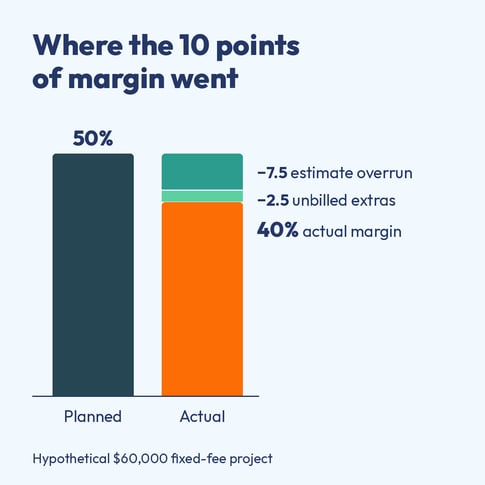
A worked example (hypothetical): A 25-person agency sells a fixed-fee website project for $60,000. The quote assumes 400 hours at a blended cost of $75 an hour: $30,000 in delivery cost and a planned margin of 50%.
The work takes 480 hours. That's 60 hours over the estimate, plus 20 hours of small extra requests nobody turned into a change order. Delivery cost is now $36,000, and the margin is 40%. The 60 extra hours cost 7.5 points of margin, and the 20 unbilled hours cost 2.5. Ten points, or $6,000, are gone, and nobody made a single bad decision.
Project margin is also different from the margin your firm keeps:
| Term | What it measures | Why it matters |
|---|---|---|
| Project margin (or project profit margin) | Revenue minus delivery cost on one project | Shows whether the work itself pays |
| Net margin | What's left after overhead: rent, software, sales, management | Shows what the firm keeps |
| Utilization rate | The share of available hours spent on billable work | Shows how much of the payroll you already pay turns into revenue |
The gap between the first two rows can be wide. In Promethean Research's 2026 agency benchmarks, agencies that tracked project margins averaged 35%, while the average net margin across agencies was 13%. And only 59% tracked project margins at all, the most basic form of project profitability analysis.
Where do service firms lose project margin?
Margin rarely disappears in one big mistake. It leaks at four handoffs: when the quote is priced, when the deal becomes a plan, when work becomes timesheets, and when timesheets become invoices. Each handoff loses a little. In many small firms, nobody owns the gap between one step and the next, so nobody sees the total.
| Handoff | How margin leaks | Early warning sign | What fixes it |
|---|---|---|---|
| Quote to plan | Gut-feel estimate; plan rebuilt by hand in another tool | Planned hours don't match quoted hours on day one | Quote from templates and past actuals, and start the plan from the quote |
| Plan to work | Small extra requests; senior people doing work sold at a junior rate | Budget burns faster than the work progresses | Contract-line budgets, alerts and change orders |
| Work to timesheet | Hours logged late from memory, on the wrong project, or not at all | Timesheets are incomplete at the end of the week | Log time where the work happens and approve it weekly |
| Timesheet to invoice | Approved hours never reach an invoice (revenue leakage), or invoices go out weeks late | Approved hours that haven't been invoiced yet | Build invoices from approved time and the contract terms |
The quote leaks first, before anyone does any work. Bent Flyvbjerg's review of behavioral biases in project management names base-rate neglect, ignoring how similar past projects went, as a primary reason projects underperform. A quote built from your own past actuals beats one built from confidence.
Scope leaks next, mostly out of sight. A client asks for one more round of changes, the team says yes, and nobody turns it into a change order. In the worked example above, 20 of those hours cost 2.5 points of margin.
Utilization leaks quietly. SPI Research's 2026 benchmark of 509 professional services firms found billable utilization fell to 66.4% in 2025, the lowest in the survey's 19-year history. Every hour below target is payroll you've already paid that never becomes revenue.
Growth makes all four worse. Promethean's data shows average net margin falling from 19% at agencies under 10 people to 12% at 10 to 24, 9% at 25 to 49, and 8% at 50 or more. Promethean links that drop to the extra management and coordination growth brings.
How can I improve project profitability with the latest management software?
The software that helps most is professional services automation (PSA) software. It keeps quotes, budgets, time tracking and invoicing in one system, so everyone works against the margin set in the quote. A quick test for any project profitability software: does a won deal become a project, a budget and an invoice schedule without anyone retyping it?
In PSOhub, each handoff works like this:
- At the quote: Smart Quotes builds each quote from your own contract, plan and budget templates and shows the margin on every line before you send it. A line that doesn't pay gets fixed while it's still a draft.
- At kickoff: When the client signs, PSOhub creates the project with the contract, budget, team and tasks in place.
- During delivery: Hours booked through time and expense tracking land on a contract line and update the budget as they come in. A contract line can lock once its budget is used up, so nobody books more time without a deliberate decision.
- At billing: Smart Invoicing builds invoices from approved hours and the contract terms, then posts them to your accounting software, such as QuickBooks, Xero or Exact Online, which creates the final invoice.
Research points the same way. In SPI Research's 2026 survey of 101 firms using PSA software, average project margin rose from 32.9% before PSA to 39.7% after, billable utilization went from 63.9% to 72.2%, and revenue leakage fell from 5.8% to 4.2%. These are self-reported figures from PSA users, so they show a direction, but can't predict your own result.
What it looks like in practice: Appronto, a software development company, starts its projects from won deals. A contract alert warns the team when a project reaches 80% of its budget, so they can talk to the client before the money runs out.
"It reminds me when we are at 80% of the contract worth, and it makes managing the project easier," says Sven Ernest, Manager of Operations. Appronto reports 8% more billable hours and 5.3% more accurate time tracking since the switch.
Want to know where your own projects lose margin? In a 20-minute discovery call, we'll look at where your quote-to-invoice chain leaks. Book a discovery call
What CRM tools help improve project profitability through client management?
Any mainstream CRM can help, whether you run HubSpot, Salesforce, Microsoft Dynamics 365 or Pipedrive. A CRM improves project profitability when its deal data flows into delivery, so the sold scope, budget and hours become the project's starting point. Which CRM you use matters less than whether that handoff happens automatically and whether the deal data is right.
A CRM manages the relationship and the pipeline. PSA software plans the people, hours and invoices. The profit comes from connecting the two.
The connection only helps if the data is accurate. Validity asked 602 CRM users in 2025, and 76% said less than half of their CRM data was accurate and complete, and 37% said poor data had cost them revenue. If the deal says 200 hours and the work needs 300, the integration just carries the wrong number faster.
Three questions to ask about any CRM and PSA setup:
- Does a closed deal create the project, or does someone rebuild it by hand?
- Do the budget, hours and billing terms come across, or only the client's name?
- Can sales see delivery hours and margin, so the next quote learns from this one?
PSOhub is a HubSpot App Partner and connects to HubSpot, Salesforce, Microsoft Dynamics 365, and Pipedrive, so deals become projects with their budget and hours already in place.
How does resource management software improve team productivity?
Resource management software improves productivity by showing who's free, who's overloaded, and what's coming, so work goes to the right person before it's late. For profitability, two things matter most: fewer paid hours sitting idle, and the right person on each piece of work, at the rate you sold it for.
That second point is where margin often slips. A quote priced for a mid-level consultant makes money. The same hours done by a senior colleague, because nobody else was free, may not. When resource management software plans people against the hours each contract line sold, you spot the mismatch while you can still change who does the work.
Digital Inside, an owner-led online marketing agency, replaced several separate tools. It reports 12% more billable hours through accurate time tracking. Owner Guido Tijmensen describes the benefit in margin terms: "PSOhub makes it easier for management to steer on what are the valuable customers and who are the bleeders in the organization."
For the wider case, including skills, overbooking, and burnout, read 8 reasons you still need resource management software. To set a realistic utilization target for your team, try our profitability and utilization benchmark calculator.
How do you forecast project profitability before the project ends?
You forecast project profitability by adding the cost of hours already spent to the cost of hours still planned, then comparing the total with the project's revenue. Do it every week while the project runs. It only works with two inputs you can trust: time logged and approved on time, and a resource plan that's up to date.
Forecast margin (%) = (revenue − (actual cost to date + planned cost of remaining work)) ÷ revenue × 100
Back to the $60,000 project. Four weeks in, the team has logged 260 hours, and the resource plan shows 200 to go. That's 460 hours, or $34,500, so the forecast margin is 42.5% against the 50% you planned. You see the slip in week four, while a change order or a staffing change can still fix it. Without a forecast, you'd find out at the end of week eight, when the margin is already 40%.
That's why resource planning and time tracking belong in the same system as the budget. In PSOhub, planned hours, actual hours, and budget sit side by side per project, so the forecast moves whenever someone logs time or changes the plan. SPI Research links integrating CRM, PSA and finance systems to better forecasting and higher project margins.
Three numbers worth checking every week
- Expected final margin per project: hours spent plus hours still planned
- Approved hours that haven't been invoiced yet
- Contract lines that have passed 80% of their budget
"I use PSOhub for that financial reporting."
Mandy, Chief Revenue Officer, Digital Reach
Or skip the report and ask. Agentic AI Insights answers questions like "which projects are over budget?" through Claude or ChatGPT, and only reads your data.
When won't software fix your margins?
Software can't fix a price that's too low, a client who's wrong for you, or overhead that grew faster than revenue. What it does is show you those problems sooner, with numbers attached. Deciding what to do about them is still your call as the owner or manager.
Pricing is the clearest case, and AI makes it sharper. Say AI helps your team finish a job in 30 hours instead of 40. If you bill by the hour, your invoice shrinks by 10 hours, and the client keeps the savings.
SPI Research's 2026 study on AI in professional services shows the gap: 84.8% of firms say AI saves them time, but only 29.9% say it brings in more revenue. To keep the savings, price that kind of work on a fixed fee or by outcome.
Habit is the second case. Half-logged hours show the wrong margin in real time. And under 10 people with a few large projects, a well-kept spreadsheet may be enough for now.
Frequently asked questions
What is a good project margin for a services firm?
A project margin around 35% is a reasonable benchmark. That's the average among agencies that track project margins, according to Promethean Research, and SPI Research's 2026 survey puts firms using PSA software at about 40%. Compare like with like: benchmark fixed-fee, retainer, and time-and-materials work separately, because each carries different risk.
How often should you review project profitability?
Review project profitability weekly for active projects and monthly across clients and project types. The weekly check compares budget used with work done and lists approved hours not yet invoiced. The monthly review shows which clients and kinds of work actually pay, which is what makes your next quote more accurate.
Should project managers see project margins?
Yes. Project managers make the daily decisions that move project margin: who does the work, whether to accept a small extra request, and when to raise a change order. If they only see hours and never money, they can't weigh those trade-offs. Finance still owns the cost rates and overhead figures.
Is fixed fee or time and materials more profitable?
Neither is more profitable by default. Fixed-fee projects pay better when estimates are accurate, because the firm keeps any time it saves. Time and materials protects the firm when scope is unclear, but caps the upside. Many services firms combine both in one contract, and either way, margin depends on tracking actual hours against what was sold.
What is the first step to improve project profitability?
The first step is to find the handoff that leaks the most margin and fix that one. If projects run over from week one, fix how you quote. If hours arrive late or wrong, fix time tracking. If approved work waits weeks to be billed, fix invoicing. One fixed handoff shows results faster than a full rollout.
Find your biggest margin leak this week
Pick one recent project and trace it from quote to invoice. Compare the hours you quoted with the hours logged, and count the approved hours still waiting for an invoice. The biggest gap tells you where to start.
Want a second pair of eyes? Book a 20-minute discovery call. PSOhub reports that firms typically see a 19% gross margin increase per year. Prefer to try it yourself first? Start a 30-day free trial.
PSOhub is professional services automation software for consulting, IT services, agency, engineering, and financial services firms. It connects to HubSpot, Salesforce, Microsoft Dynamics 365, and Pipedrive.
Share this